Swimming offers many benefits for children, but for children and adolescents with special needs, learning to swim can be especially valuable. At Well Cares Swimming, we provide specialised swimming lessons for children and adolescents with autism (ASD), ADHD, Down syndrome, developmental delays, learning difficulties and other additional support needs.
We understand that every child experiences the world differently. Some feel naturally comfortable in the water, while others may experience anxiety, sensory sensitivities, communication difficulties or challenges with coordination and motor skills. Our approach is based on patience, understanding, positive encouragement and individual attention.
We teach in (small) groups, but our approach is individual. Rather than following a rigid teaching programme, we adapt our swimming lessons to each swimmer’s abilities, needs and personal goals. This allows every child to learn, develop and enjoy being in the water at their own pace.
Our priority is always water safety, but our ambition goes further: helping children discover confidence, independence and the joy of swimming.
Water Safety. Building confidence and essential life skills
Water safety is particularly important for children with special needs. Research has shown that children with autism spectrum disorder may face a significantly increased risk of drowning. Factors such as wandering, reduced awareness of danger, sensory processing differences and difficulties responding to unexpected situations can contribute to this risk.
For this reason, we place a strong emphasis on developing practical water safety skills. Our swimming lessons focus on becoming familiar with the water, understanding buoyancy, learning to float, controlling breathing, moving safely through the water and gradually developing independent swimming skills. We also practise skills that can be valuable in real-life situations, such as staying calm after unexpectedly entering the water, finding support and moving towards a safe exit.
Not every child follows the same learning pathway. For some, becoming comfortable in the water and developing basic water safety skills may be the main objective. Others may progress towards independent swimming, more advanced techniques or official Dutch swimming diplomas, including the A, B and C diplomas.
We discuss these goals with parents and regularly evaluate each child’s progress, adjusting our approach whenever necessary.
Swimming lessons can help children develop essential water safety skills, but they never replace close adult supervision around water.
Parent involvement; learning together through trust and communication
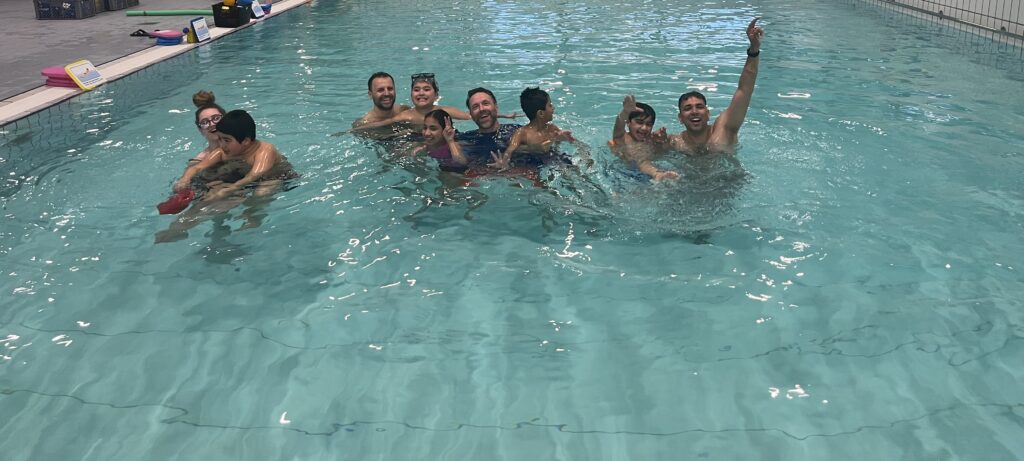
One of the most important elements of our special needs swimming programme is the active participation of a parent or caregiver in the water.
At Well Cares Swimming, we require a parent or caregiver to join their child in the water throughout the swimming lesson. This is an essential part of our teaching method, both for safety and for providing the best possible individual support.
Having a familiar and trusted person nearby can help children feel more secure, particularly when they experience anxiety, sensory overload or difficulty adapting to new situations. A parent can provide immediate reassurance, encouragement and physical support when needed.
But parent involvement goes much further than safety. We believe that parents know their children best, and we want to learn from that knowledge. A swimming coach understands swimming techniques and teaching methods, but parents recognise the individual signals, behaviours and emotional responses of their child. A particular look, facial expression, movement or change in behaviour may communicate excitement, uncertainty, discomfort or the beginning of frustration. These signals are not always obvious to someone who is still getting to know the child.
Through open communication, we learn from parents what works best. What motivates your child? What makes them smile? How do they respond to new experiences? What situations might cause stress, resistance or sensory overload? How can we recognise when a child is approaching their limits?
Equally important, we want to understand what we should avoid. Some children may find unexpected physical contact, loud instructions, unfamiliar equipment, changes in routine or particular exercises challenging. Others may become overwhelmed, withdraw or experience a temporary learning block when they feel pressured, anxious or unsafe. Recognising these signals early allows us to adjust our approach before frustration or anxiety increases.
We never want to force a child through an exercise simply to achieve a result. Instead, we work together to understand what is causing the difficulty, rebuild confidence and find an alternative way forward. Sometimes this means taking a short break, returning to a familiar activity, changing an exercise or simply giving the child more time.
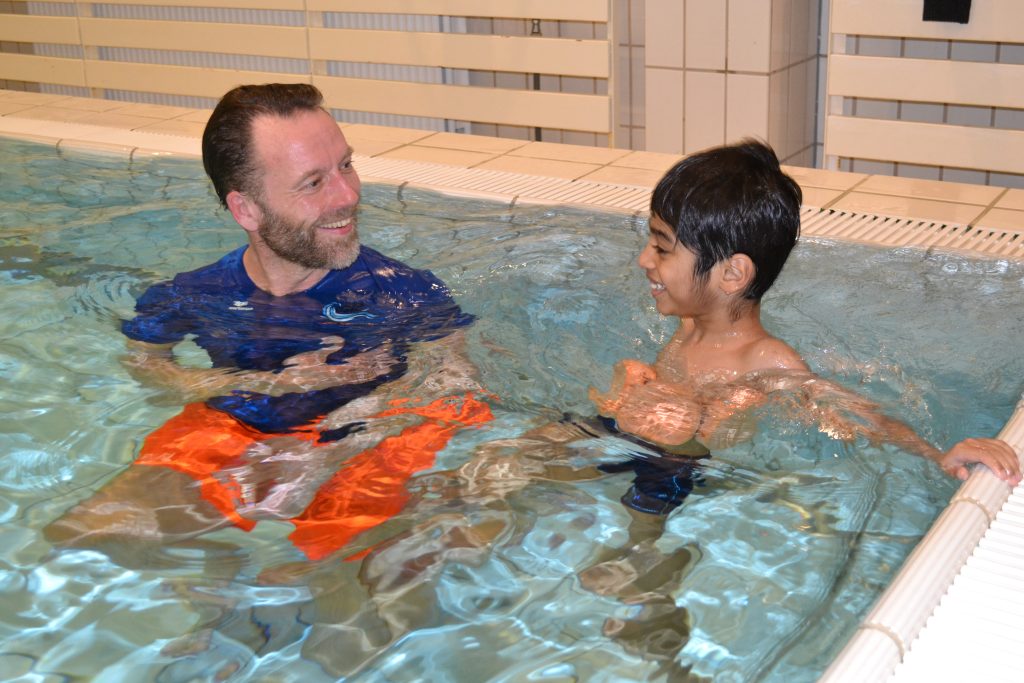
During lessons, the swimming coach explains and demonstrates exercises, while the parent actively supports and guides the child. Together, we observe how the child responds, exchange feedback and adapt the activities when necessary. We call this partnership ‘the golden triangle’: child, parent and swimming coach.
By combining our professional swimming knowledge with the parent’s understanding of their child, we create a consistent and supportive learning environment where children feel understood, encouraged and safe enough to explore new skills.
Relaxation, Sensory comfort and Enjoyment
For many children and adolescents with special needs, water can provide a unique sense of comfort, freedom and relaxation. The gentle pressure of the water, the feeling of buoyancy and the repetitive nature of swimming movements may have a calming effect. Water also supports the body, allowing children to explore movements that may be more difficult on land.
However, we recognise that every child has a different sensory experience. While some children find water soothing, others may initially feel overwhelmed by splashing, noise, water temperature or unfamiliar sensations. Our swimming coaches take these individual differences seriously.
By creating predictable routines, using familiar exercises and introducing new activities gradually, we aim to help children feel comfortable, secure and in control. Our (small) group swimming lessons allow us to provide personal attention and adapt activities to each child’s sensory needs and abilities.
Play and enjoyment are essential parts of our teaching philosophy. Through games, simple challenges and positive encouragement, children can practise swimming skills without feeling that every activity is a formal exercise. We believe that enjoyment is not separate from learning. When children feel happy, relaxed and motivated, they are often more willing to explore, participate and try new things.
Our aim is to make swimming lessons something children look forward to, rather than something they feel they have to do.
Social development, motor skills and physical confidence
Swimming lessons can support much more than water safety. For children with autism, ADHD, Down syndrome and other additional support needs, swimming provides opportunities to practise social interaction, coordination, body awareness and physical movement.
Social interaction and Communication
During swimming lessons, children may practise waiting for their turn, following instructions, sharing equipment, recognising boundaries and interacting with their swimming coach, parent and other children. For children who find social situations challenging, these experiences can provide valuable opportunities to develop communication and cooperation skills in a supportive setting.
We adapt our communication to each child. This may involve short verbal instructions, visual demonstrations, repetition, gestures or allowing extra time to process information. We recognise that communication does not always involve spoken language or eye contact. Our aim is to understand how each child communicates and respond in a way that makes them feel comfortable, respected and understood.
Gross motor skills, Coordination and Strength
Swimming is a low-impact physical activity that engages many muscle groups while reducing the load on joints. Regular swimming activities can help children practise balance, coordination, body awareness, muscle strength and endurance. The supportive properties of water may also allow children with physical or motor difficulties to experience greater freedom of movement.
We adapt exercises to each child’s physical abilities, focusing on achievable challenges and gradual improvement. Every small success can contribute to a stronger sense of independence and physical confidence.
Confidence, Independence and Personal achievement
For many children with special needs, learning a new skill can require additional time, repetition and encouragement.
At Well Cares Swimming, we believe that progress should always be measured against a child’s own abilities and starting point, not against the achievements of others. For one child, putting their face in the water may be a major breakthrough. For another, swimming a short distance without assistance, reducing the use of swimming aids or moving into deeper water may represent an important milestone. We celebrate these achievements because they build confidence, motivation and a sense of accomplishment. As children become more familiar with the water, they may gradually develop greater independence and a stronger belief in their own abilities.
Our swimming programme offers different learning pathways depending on each child’s progress and personal goals. Some children focus primarily on water orientation, enjoyment and essential water safety skills. Others work towards independent swimming, official Dutch A, B and C swimming diplomas or more advanced swimming techniques. We also offer opportunities for children and adolescents who have already developed basic swimming skills and are ready for additional challenges.
Whether the goal is improved water safety, greater independence or achieving a swimming diploma, we work closely with parents to determine realistic and meaningful objectives. Our goal is not to make every child achieve the same result. Our goal is to help every child achieve their own best possible result.
Financial support: Jeugdfonds and PGB
We believe that every child should have the opportunity to learn to swim, regardless of their family’s financial circumstances. Depending on eligibility and individual circumstances, financial support for swimming lessons may be available through Jeugdfonds Sport & Cultuur or a Persoonsgebonden Budget (PGB). We are happy to discuss the possibilities and help parents explore suitable funding options.
Discover our special needs swimming lessons
Every child is different, and we understand that choosing the right swimming lessons is an important decision for parents. That is why we welcome the opportunity to discuss your child’s needs, abilities, previous swimming experiences and personal goals before getting started.
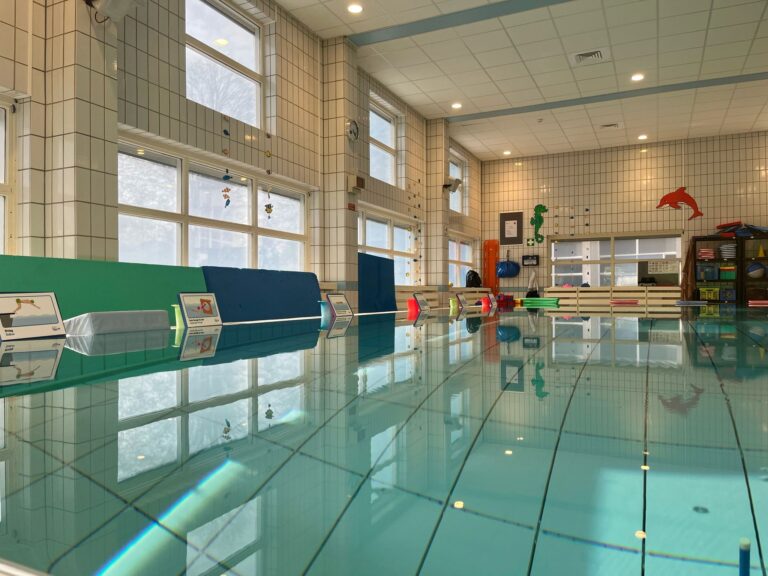
A try out swimming lesson can be a valuable first step. It gives your child the opportunity to become familiar with the swimming pool, meet the swimming coach and experience our teaching approach. It also gives us the chance to observe how your child responds in the water and discuss together which exercises, support and learning environment may work best. There is no pressure to achieve a particular result during a first lesson. Our priority is to create a positive introduction and begin building trust.
Special needs swimming lessons near you in Amsterdam, Amstelveen, Diemen and Aalsmeer
Are you looking for swimming lessons for children with special needs near you?
Well Cares Swimming offers specialised swimming lessons in the Amsterdam region, including selected locations in Amsterdam, Amstelveen, Diemen and Aalsmeer.
Our special needs swimming lessons are designed for children and adolescents with autism (ASD), ADHD, Down syndrome, developmental delays and other additional support needs. With (small) groups, individual attention and active parent involvement in the water, we create a safe, supportive and enjoyable environment where every child can learn at their own pace.
Whether you are searching for autism swimming lessons in Amsterdam, swimming lessons for children with special needs in Amstelveen, or adapted swimming lessons in Diemen or Aalsmeer, we are happy to help you find a suitable class.
Ready to take the first step?
Register your child today, and we will contact you to discuss their individual needs and arrange a suitable trial swimming lesson. Together, we can take the first step towards a safe, positive and enjoyable swimming experience.
Monday: 18.30 – 19.15 location Meerkamp, Van der Hooplaan 239, Amstelveen
Wednesday: 16.00 – 16.45 location Reade, Overtoom 283, Amsterdam
Friday: 19.00 – 19.45 location De Mirandabad, De Mirandalaan 9, Amsterdam
Saturday: 09.15 – 10.45 location De Waterlelie, Dreef 7, Aalsmeer
Sunday: 09.30 – 12.30 location AGO pool, Kriekenoord 17, Diemen
Sunday: 16.45 – 19.00 location De Werf, Klinkerweg 79, Amsterdam